Fill in your email below & new entries will come directly to your inbox. Neat, huh?
Showing posts with label George Donahue. Show all posts

Tuesday, December 27, 2011

SMILE: This Too Is Karate

This past week, I have had the pleasure of working out on both Thursday and on Monday with several of my students. The holidays tend to lure people home. And our dojo is a kind of home. Most of my students have been with me for at least 8 years. Some of them as many as 15. The atmosphere is familiar: warm, chatty, plenty of inside jokes and smiles. 


There have been times in the past in which I missed the "edge" of a more formal training environment-- the performance pressure and rapid-fire challenge. But working out alone is, surprisingly, something of a pressure cooker. Working out with others is a welcome hiatus from the scrutiny, responsibility and discipline of going up to the training floor with me, myself and I.


I learned long ago the power of smiling. At Sensei Rosati's dojo, we would do endless Jumping Jacks and interminable sit-ups. I quickly discovered that the best remedy for the uncertainty and discomfort was to smile. The longer it went on, the more I smiled and the more I smiled, the easier it got.


Since that time, I have read scientific studies that support my experience. While everyone knows that happiness brings smiles, it seems that the reverse is also true: smiling, just the physical act of activiting those hundreds of tiny facial muscles used in the act of smiling, appears to stimulate happiness.


In my running practice, now transformed into something of a Chi Running practice, I find the same effect. I enjoy. I smile. I smile and the world seems to light up around me. And I enjoy even more. Relaxing is easier. Breathing is easier. My last run was so enjoyable, in fact, that I skipped over my 30 second walking intervals and just ran. For the joy of it.


So, was it the smile that brought out the joyous energy or the joy that produced the smile? I know what my teacher George Donahue would say. 


Whenever I ask him if *this* or *that* is the correct position for a stray hand or foot, he inevitably answers: "Well... It depends." "Then, which way should I practice it?" I unfailingly ask. "Both," he inevitably replies.


Both.

Saturday, December 10, 2011

Pokeless in Rehovot

Chogi Kishaba- Armed & dangerous
For unknown reasons, I entered into the new week with a desire to practice. Unusual. Generally, the end of a restful Shabbat brings out the restlessness in me. My running shoes go on and off I go. Tonight, my gi pants went on and up I went, a woman with a mission.

Starting with Naihanchi, I went through all my kata, loosening the arms, tightening the lats and activating the hikite. An experiment that is typically Kishaba Juku: How does it affect my body mechanics? What practical advantages does it have? What problems does it raise? 


And typically mindfulness meditation: How does it feel? And noticing how easy is it to forget to pay attention whenever the mind begins to wander.


I was on a roll, so I figured, why not get into my weapons kata as well? I had spent some time in the Fall, working on Sai but I hadn't swung a Bo staff with any seriousness since my visit to George Donahue in August. 


That was when I discovered a fundamental fault in my Yamane-ryu Bo swing. No poke.


Bo has never been my forte. It was my first weapon and certainly the one with which I have the most experience. And the most frustration. After more than 20 years of swinging the bo, I have picked up a few things, but have had no real sense of making progress. I know a few kata. I have gotten better at impressing people who don't know what they are looking for. However, whenever I swing the bo for one of my teachers, I get that "where-shall-I-begin" look and instructions to keep practicing. 


This time was different. This time George was able to point out something very specific that I was doing wrong. Something I could work on. No poke in the swing. That is, I was cutting the air as if I was swinging a sword, as if my goal was to strike my opponent where the neck meets the shoulder. However, I was not stabbing in, as if I intended to skewer him through the throat as well. 


It took me a while to understand what he wanted. When I understood, I was struck by the fact that this striking-blocking-stabbing concept was exactly parallel to the way I had been taught to strike-block in empty-handed karate when I switched from doing straight Shorin-ryu Matsubayashi to the body-mechanics oriented Shorin-ryu Kishaba-Juku.


My demons wasted no time stirring me up. How could I have missed something so fundamental for so long?  And when I tried to make the change that August day, I found the older habit so ingrained, it was nearly impossible for me to even imitate the new movement.


And why hadn't I noticed it before?


Switch back to tonight. Maybe it was the restfulness of the day. Or the sense of accomplishment I had from practicing my other kata. Or the relaxation of inhibitions that comes after a workout. 


But I worked on my bo swing by striking at the heavy bag, poking the letters printed on it and drawing back into a block. And then I worked on my kata, letting myself forget the details of the moves but forcing myself to poke when I struck. 


I found that the physical issue was not as daunting as the conceptual one. I thought I understood the strike; I thought I simply wasn't doing it right. It turned out that I never understood the strike at all.


Over the years, I had worked on speed, on looseness, on the elliptical throw. The poke, stabbing into the target in the middle of the strike, meant everything else would have to change. But change to what? 


However, at least for one night, I gave up the pursuit of perfection for the satisfaction of investing in change. Can I strive to make a change in my way of being, at least with the bo, and be satisfied merely with that?


For one night, apparently so. The rest of eternity will have to wait, at least until tomorrow.


Thursday, December 8, 2011

Beginner's Mind, Eureka Addiction and Naihanchi


Slowly, very slowly, my voice has been returning and, with it, my strength and ability to concentrate and work out. Interestingly, running came back to me much more easily than karate. Running is a much harder physical workout but it requires very little mental or emotional investment. I have managed to sustain a healthy relationship with it so far. Any effort feels worthwhile.


Karate, on the other hand, is an art form and one in which I invested a great deal. So I have expectations. 

For example, my expectations of my students are that they show up and make an effort. That they be respectful and honest. And that when it is time for them to move on, that they will have the integrity and confidence to look me in the eye and say goodbye. 

I used to think that was not a lot to ask. I have learned that it is.

As for myself, I am still trying to figure out what my expectations are. All I know is that they are high. High enough that I often have to drag myself up to the dojo to practice. With no colleagues to hide among and no students to teach, I'm all alone there on the dojo floor. Me, my perfectionism and I.

Lesson #1: Beginner's Mind is NOT... avoiding practice knowing you'll always fall short of your own expectations.

This week I had the privilege of substituting for one class of a Karate/ Martial Arts Instructor Course. The Head Instructor asked me to teach about my style. Once i accepted, it didn't take long for the demons to catch up with me. 

How could I possibly represent my style? All I could do was run mental clips of George Donahue, Paris Janos, and Chris Walton, not to mention Shinzato-sensei and think: "Look at that. I can't do that. I'm still a Beginner (6-7 years later); how can I show them anything?"

After far too much time worrying,  I finally got to teach the class: relaxed, enjoyable. No problem. 

I started with a little history of Okinawan karate to help them understand the context of the art, in particular how it is related to Shotokan karate, the style most of them represent. We ran through some concepts: moving from and through the center, koshi, Figure 8s, arches, compression, torque... and did some exercises that play with those concepts. And I threw some of Sensei Rosati's Yakusoku Kumite at the end, just for fun. 

In other words, there are, in fact, some things that I know and some things I can do. I don't know them or do them nearly as well as my teachers, but I still have plenty to show to people who either don't do them at all or haven't had the opportunity to focus on them as I have.

Lesson #2: Beginner's Mind is NOT.... insisting that you still don't know anything.

So, today, I was ruminating about what to practice. That's Something you don't have to worry about when you run--- Just turn on the music and run. And it's something you don't have to worry about when you go to class. Someone else does the worrying for you. When I finally managed to skirt around all the obstacles I threw in my path and got upstairs to practice, I decided to practice Naihanchi. And Naihanchi. And Naihanchi. And Naihanchi....Over and over again.

Not my first kata. Not my fanciest kata. Not even a wall-to-wall run-through of all of my kata. Just the one kata that, according to Kishaba Juku, serves as the basis for rediscovering and revitalizing them all.

I think I  may know what I am looking for every time I climb those stairs up to the dojo. I'm looking for a mini-epiphany. I have had so many of them since I began to practice Kishaba Juku that I am thoroughly addicted. I expect at least one every time I practice. Totally unreasonable. What teacher could possibly meet an expectation like that? And, because I am alone, the teacher that I expect to be that brilliant every time s/he steps on the deck...is me.

So, I have plenty of meditation and spiritual practice ahead on taming my Ego. Tormenting myself doesn't seem to work. Neither does selling myself short...

And, about that epiphany? Yeah. I had one. Something about the looseness of the arms, the snap it creates and changing directions. I've already started worrying about whether I'll be able to remember what it was next time I practice.

Addiction-1, Reasonable expectations-0. And counting.


Thursday, November 10, 2011

Getting Past The First Move

First of all, allow me to introduce you to the newest member of Dojo AISH. I used some pre-workout energy today building this eminently punchable being on the basic plan that I featured in the last posting with a few twists.


First of all, I already had a small punching bag hanging from our speed bag platform. I just dressed it up with an old jacket. As I was filling the arms with old newspapers, I decided that something in lieu of a bone structure might be helpful for arm bars and such. I took a thick cardboard roll, similar but heavier and longer than the kind you find in paper towels. I cut it in haf and then divided each half into an upper- and lower-arm by cutting most of the way through but not separating the parts.Then, I filled the arms and gloves with bunched-up newspapers and taped the gloves to the arms.
Presto! Instant Bad Guy.


I started out the more official part of my practice day on a wobble board. A wobble board, in my case, is two boards joined together unevenly along their lengths. You can also make one by wrapping tape thickly around each end of a 2 X 4. The idea is to make a standing surface with limited stability. If you stand on it and strike without centering and lowering your center of gravity, you fall off.


The wobble board/ Training Buddy combo was equally satisfying and humbling.

Then, as I was practicing kata, I occasionally wandered over to my New Friend to try combining striking and grabbing techniques from the kata. Hey, its not as much fun as twisting a student's arm and a takedown but, hey, you can't beat the patience and availability, not to mention the quiet :-).


Kata practice today was a mixture of Fukyugatas, Pinans and Wanshu. Still working on picking up the new material on Wanshu and then transposing the lessons learned to lower kata. For example, in Fukyukata Ni (Geikisai Dai), that sweeping, dramatic shuto-uchi sword strike on each end of the kick-elbow-downblock-punch combo? Well, with a little imagination, it can start out as an elbow strike and do all kinds of nasty things on the way to its ultimate destination. Try it and see.


Meanwhile, as I was watching more of George's videos, I started calculating how much time was spent on the First Moves of the katas. Sometimes when I work out with the Kishaba Juku crew, I get the feeling that we will never get past the first move. And, if the first move is so bad that it needs 3 hours of work, how good can the rest of the kata be?


Then it came to me. If you can't beat'um, join 'um. So i finished up today's session just practicing opening moves for each kata, full speed, full power, first on the left and then on the right. 


Try it yourself. I'll be doing more of that for my next session so I should have plenty to say about it next time.

Tuesday, November 1, 2011

Washite: Holding On, Letting Go

Thank God there are people around like Christopher Caile, the editor of FightingArts.com. He is a connoisseur of traditional martial arts, a dedicated student of Internet technology and, in terms of stubborness, at least, more than a match for the elusive George Donahue. That is the only explanation I can offer for the number of articles he has managed to squeeze out of George on a number of practical and fascinating subjects related to the martial arts.


For today's workout, I re-read the article: The Martial Grip- Washite, the "C" Grip by George Donahue. 

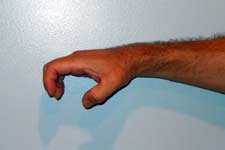
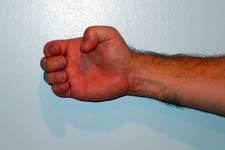
In his article, George explains that washite ("wa•shi•te, rhymes with “laundry day” and means, literally, “eagle hand”") is one of the martial arts' most useful gripping techniques. Featured  in numerous kata, including Rohai, Wanshu, and Passai,  washite is often called a "C" grip, because it looks like the letter "C".


From the side, basic washite, with fingers together, looks like a “C.”

Basic washite, “C” grip, palm view.
Washite's open grip allows us to use leverage and focused force to convert our hands into something like the kind of can opener used to punch a triangular hole in the top of a can. It also allows us to change the fulcrum and leverage points from the thumb to the finger tips and back again ( can you spell p-a-i-n?) or to pair  only one or two finger tips with the thumb and free the other fingers to attack other pain points.

In terms of attack, Washite can be used to drill into vital nerve points, separate muscle from bone and connective tissue, and apply leverage to limbs. Logical, right? 

But it also has another function, he says. It helps us let go.

George writes: "When we grab someone with vigor or urgency, we invest a lot of ourselves in the grab. We tend to hold on for dear life, even when it’s counterproductive to do so. If and when it becomes clear to us that it would be better to let go, there is always a delay that’s proportionate to the intensity of the grip—the release is often dangerously slow. 

Interesting isn't it? I find it natural to associate the martial arts with power and tenacity. Yet, in some respects the closed fist is weaker than the open hand. And, just as learning how to "hang on" is a warrior skill, so is it a warrior skill to learn how to let go.

So tonight it's Rohai, Wanshu and Passai, learning how to hold on and learning how to let go.